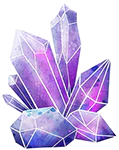

Beryl — hexagonal rings and the full color palette
Beryl — one architecture, many moods. Imagine silicate ring honeycombs stacked into long hexagonal columns; then place small guests into the channel voids — water, alkaline elements, and trace metals. These “guests” tune the color: ocean blue, garden green, soft rose, sunrise yellow, even legendary ruby red. Same framework scheme, different stories.
Identity and structure 🔎
Six-ring framework
Beryl — Be₃Al₂Si₆O₁₈. Its silicate tetrahedra connect into six-membered rings stacked like coins along the c axis. These stacks form channels that hold water and small ions. Substitutions at Al/Si sites and different “guests” in the channels adjust color and optics.
Color logic (briefly)
- Cr³⁺/V³⁺ → green emerald.
- Fe²⁺ (± Fe³⁺) → bluish to blue-green aquamarine.
- Mn²⁺ → pink morganite; Mn³⁺ → red beryl.
- Fe³⁺ → yellow heliodor.
- Few chromophores → colorless goshenite.
Channel ions and irradiation can create “maxixe-type” deep blues — striking but often light sensitive.
Colors and varieties 🌈
Emeralds
Rich green from Cr/V. Usually heavily included (“jardin”) and often filled with oil/resin to improve clarity. Step cuts preserve corners and frame the color.
Aquamarine
Blue to bluish green from Fe; mild heating often removes green/yellow, leaving clearer blue. Usually clearer than emerald, ideal for long, clean prisms and elegant cuts.
Morganite
Pink/peach from Mn; heating shifts toward pure pink (reduces peach tone). Often large, clean crystals — perfect for softly glowing cabochons and facets.
Heliodor / golden beryl
Yellow from Fe³⁺; some pieces turn aquamarine tones when heated. Cheerful, high-clarity beryl for bright cuts.
Goshenite
Colorless beryl — optically clear, a playground for cutters. Historically used for “beryl lenses.”
Red beryl
Exceptionally rare raspberry red (Mn³⁺). The gemstone quality is the most famous from Utah; crystals are small but intense.
One lattice, six personalities. Like a family reunion where everyone really gets along.
Where it forms 🧭
Pegmatites (beryl's "cradle")
Most beryl grows in granitic pegmatites — coarse-grained magmatic vein bodies rich in rare elements and water. Slow cooling promotes large, clean crystals: aquamarine, morganite, goshenite, heliodor.
Emerald's special chemistry
Emerald needs Be from granitic solutions and Cr/V from mafic/ultramafic rocks. Where these meet — black shales, schists, carbonates and hydrothermal veins — emerald is born. A geological cocktail party.
Red beryl niche
Forms in rhyolite volcanic systems thanks to low-temperature pneumatolytic solutions. The chemical window is very narrow — that's why it is so rare.
Palette and hábito dictionary 🎨
Palette (family portrait)
- Emerald green — rich, somewhat bluish to yellowish.
- Sea blue — the cool axis of aquamarine.
- Soft rose — the peaceful tone of morganite.
- From citrine to honey — the sun of heliodor.
- Raspberry — a rare spark of red beryl.
Backlit edges often show candle glow; pleochroism changes tone with orientation (especially in aquamarine and morganite).
Hábito words
- Hexagonal prisms — long, striated columns, flat pinacoids.
- Etching marks — natural dissolution pits on prism faces.
- Trapiche (emerald) — rare six "spoke" growth sectors with angular bands.
- Massive/granular — common in the cores of morganite and goshenite pegmatites.
Photography tip: Soft diffuse light suits emerald — highlights the "jardin" and color. For aquamarine prisms, add low side light (~25–35°) to emphasize striations without washing out the blue.
Physical and optical properties 🧪
| Property | Typical value / note |
|---|---|
| Chemistry | Be₃Al₂Si₆O₁₈ with traces of Cr/V/Fe/Mn; channels may contain H₂O/alkalis |
| Crystal system / habit | Hexagonal; prisms, striated lengthwise; massive |
| Hardness (Mohs) | ~7.5–8 (emerald can behave "brittle" due to inclusions) |
| Relative density | ~2.63–2.90 (varies with composition/inclusions) |
| Refractive index | ~1.57–1.60; double refraction ~0.004–0.009; uniaxial (−) |
| Pleochroism | Weak→medium; aquamarine stronger (blue ↔ almost colorless); emerald weaker |
| Cleavage / fracture | Imperfect basal {0001}; fracture shell-like→uneven |
| Fluorescence | Varies: emerald often inert/slightly red; morganite sometimes faintly orange; aquamarine usually inert |
| Treatments | Heating (aquamarine/morganite/heliodor); emerald oil/resin filling; some blue/yellow — irradiation (maxixe-type) |
Under the loupe 🔬
Emerald characteristics
Classic "jardin" — fractures, veils, and three-phase inclusions (liquid + gas bubble + crystal). Filled stones may show rainbow flashes in fractures; some resins fluoresce.
Aquamarine and friends
Look for growth tubes parallel to the c axis, fine mica/ilmenite dots, and angular zoning. Pleochroism is clear with a dichroscope: blue vs. almost colorless.
Red beryl and morganite
Fine grainy texture and small crystals — normal for red beryl; morganite is usually cleaner, with gentle swirling zoning. Both can show healing "fingerprints."
Similar and easily confused 🕵️
Emerald "twins"
Green glass (bubbles, low RI/SG), green tourmaline (stronger dichroism, different RI), peridot (higher RI, different doubling), and chromdiopside (greater double refraction). The Chelsie filter often colors Cr-emeralds red.
Aquamarine “twins”
Blue topaz (higher RI ~1.62–1.63; stronger double refraction), spinel (no pleochroism), and glass (bubbles, low hardness).
Morganite and heliodor
Kunzite (stronger pleochroism, perfect cleavage), rose quartz (cloudy, possible asterism), citrine (trigonal quartz; different RI) can mislead at first glance.
Red beryl
Ruby/spinel are harder and denser; red beryl RI/SG matches the beryl family, and crystals are usually small prismatic hexagons.
Synthetic and composite
Hydrothermal/flux synthesis — a true emerald grown in a lab; growth features and inclusions differ. There are doublets/triplets and green bases — loupe and lighting tell the story.
Quick checklist
- Hexagonal habit, RI ~1.58, weak pleochroism? → beryl family.
- Cr/V reaction, “jardin,” stepped cut? → emerald.
- Blue, deeper along the c axis? → aquamarine.
Localities and notes 📍
Pegmatite classics
Brazil (Minas Gerais) — aquamarine/morganite/heliodor; Pakistan and Afghanistan (Skardu, Nuristan) — sky-blue aquamarines; Madagascar — pastel morganites; Nigeria and Mozambique — clean blue and golden beryls.
Emerald belts
Colombia (Muzo, Chivor) — rich greens and classic inclusions; Zambia (Kafubu) — deep bluish greens; Brazil (Itabira/Nova Era), Afghanistan/Pakistan (Panjshir/Swat), Ethiopia, Russia (Urals). Each region has its own “signature.”
Care and lapidary notes 🧼💎
Daily care
- For all beryls: lukewarm water + mild soap; soft brush; rinse and dry.
- Emeralds: avoid ultrasound, steam, heat and aggressive solvents — fillings can leach out or turn whitish. Handle like a silk blouse.
- Keep separately; hardness is high, but corners can chip from strong impact.
Jewelry recommendations
- Emeralds love bezels and protective settings; step cuts are classic for beauty and durability.
- Aquamarine and heliodor like bright facets and open setting styles; orientation perpendicular to the c-axis deepens the blue.
- Morganite shines in larger cuts with soft crowns; rose gold warms it beautifully.
On the wheel
- Pre-polishing 1200→3k; finishing with aluminum oxide or cerium oxide on leather/felts.
- Respect the base cleavage direction — support thin edges, use light pressure.
- For emeralds, plan according to inclusions; a slightly deeper pavilion depth can enrich color without overloading.
Questions ❓
Is heat treatment standard?
Yes, for aquamarine and often morganite/heliodor, to enhance color. This is considered normal when disclosed. Emerald is rarely heat-treated; instead, it is often filled with oil/resin to make fractures less visible.
How to recognize if an emerald is filled?
Look for rainbow flashes in fracture lines and differences in luster under a loupe. Some fillers fluoresce; reliable labs assess the level of treatment.
Does aquamarine fade?
Natural Fe-blue is usually stable. Maxixe-type deep blue after irradiation can fade in sunlight — most jewelry aquamarines are heat-treated, not irradiated.
Is red beryl really that rare?
Yes. Facetable suitable crystals are small and rare; the most famous source is the Wah Wah Mountains in Utah. Even small, clean stones are of collector's quality.
What does "trapiche emerald" mean?
Rare growth patterns: six radial sectors separated by dark, carbon-like "spokes" — like a wheel. Impressive and highly collectible when natural.