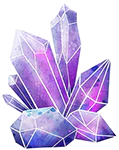

Rodochrosite — pink bands and stone hearts
Rodochrosite is like a love note written in the language of geology. From raspberry-red crystals to cotton candy stalactites, banded pink and white — it is instantly recognizable and quickly beloved. It is softer than many gemstones and cleaves like calcite, but the reward is a glowing, romantic color. (Yes, you can gasp. So do we.)
Identity and name 🔎
Rose by nature
Rodochrosite name comes from Greek rhódon (rose) + chróma (color). The pink color is given by Mn²⁺ in the lattice. When Mn is replaced by Ca/Fe/Mg, the colors change; as Mn decreases, tones can shift to peach.
Two personalities
- Banded stalactitic — "Inca roses" style sections with concentric pink–white ring bands and botryoidal faces.
- Crystalline — shiny rhombohedra/scalenohedra, often on quartz, sometimes with tetrahedrite, pyrite, or fluorite.
Where it forms 🧭
In hydrothermal veins
Low-temperature, metal-rich fluids precipitate rhodochrosite along with quartz, calcite, sphalerite, galena, pyrite, tetrahedrite. Excellent crystals grow in open cavities; banded vein fillings in fractures.
Cavity chemistry
In volcanic and sedimentary environments, carbonate waters seep through cavities and grow stalactites. Each chemical "pulse" deposits a new pink or white ring — like growth rings in a candy cane.
Alteration history
Near the surface, pink can be covered by manganese oxides (brown/black spots). Metamorphism can turn Mn carbonate into Mn silicates (e.g., rhodonite) in transformed rocks.
Recipe: manganese + carbonate + time. Optionally — quartz "snow drifts" for contrast.
Palette and variety glossary 🎨
Palette
- Pink to raspberry — classic "rhodo".
- Peach hue — less Mn or more calcite.
- Snow-white bands — calcite layers in stalactites.
- Soft bluish accents — from adjacent fluorite or contrasting lighting.
- Brown/black "veils" — manganese oxides on the edges.
Transparent crystals can be bright cherry; massive sections glow "chewing gum" pink in transmitted light.
Variety terms
- Rhombohedra — characteristic of the calcite group "oblique cubes".
- Scalenohedra — elongated "dog tooth" shapes (rarer than calcite).
- Botryoidal — "grape-like" hemispheres with a silky luster.
- Stalactitic — columnar growth with concentric ring bands in cross-sections.
Photo tip: Use soft main light + small side "kicker"; place a thin section on a transparent stand and gently illuminate from below — rings will light up instantly.
Physical and optical details 🧪
| Property | Typical range / note |
|---|---|
| Chemistry | MnCO₃; solid solution with Ca/Mg/Fe (pink fades with decreasing Mn) |
| Crystal system / varieties | Trigonal (rhombohedral); rhombohedra, scalenohedra, botryoidal and stalactitic masses |
| Hardness (Mohs) | ~3.5–4 (softer than quartz; protect in rings and displays) |
| Relative density | ~3.5–3.7 (heavier than calcite) |
| Cleavage / fracture | Perfect rhombohedral in 3 directions; uneven fracture; brittle |
| Luster / transparency | Glassy (pearly on fracture); in masses — from transparent to opaque; crystals can be clear |
| Streak color | White |
| Fluorescence | Variable (often weakly orange-red; depends on locality) |
| Chemical behavior | Slightly fizzes in cold diluted HCl; strongly when ground or heated |
| Treatments | Usually none; plates sometimes stabilized for lapidaries; specify if applied |
Under the magnifier 🔬
Rings and "bubbles"
In stalactitic sections, concentric pink–white bands and sometimes void centers where growth began are visible. Fine "seams" mark chemical pauses.
Crystalline features
Rhombohedral surfaces with pearly cleavage in three directions; edge indentations form tiny, mirror-like steps at rhombohedral angles.
Satellites
Look for quartz druzes, calcite (often white), tetrahedrite, pyrite, fluorite, and brown/black Mn oxides framing the pink.
Similar and confusing 🕵️
Rhodonite (Mn silicate)
Harder (5.5–6.5), often with black Mn oxide veins; does not fizz; cleavage different. Rhodochrosite is softer and (gently) fizzes.
Cobalt/manganese calcite
Bright magenta to “bubblegum”; often strongly fluorescent. Hardness ~3; banding different (more often “sugary” texture).
Pink smithsonite
ZnCO₃; heavier (SG ~4.4–4.5) with satiny luster; also can be botryoidal. Weight feel and luster comparison help.
Peruvian pink opal
Waxy, often opaque; no cleavage, does not fizz; harder (5–6.5). Color more even.
Quick checklist
- Soft pink + rhombohedral cleavage?
- Concentric bands in sections?
- Gentle fizzing in warm/diluted acid? → Rhodochrosite.
Localities and histories 📍
Where it shines
Iconic crystals — from Colorado, USA (Sweet Home mine near Alma — cherry rhombs on quartz), South Africa (N’Chwaning — rich scalenohedra) and Peru and Romania (elegant vein specimens). Banded stalactites are famous from Argentina (often called “Rosa del Inca”).
How it is used
As a collector's mineral, for cabochons and small sculptures (carefully), historically — as a secondary manganese ore. Thin sections and “crystal on quartz” in galleries often captivate hearts — often literally carved into hearts.
Care and lapidary 🧼💗
Daily care
- Clean with lukewarm water + mild soap; rinse quickly and dry.
- Avoid acids, vapors, ultrasound and long soaking; pink may corrode, the stone may crack.
- Keep separately, in soft lining material; protect from sudden shocks.
Jewelry guidelines
- Best for pendants, earrings, brooches; rings need protective settings and careful wearing.
- Open backs for sections allow pink to glow against the light.
- Over time, gentle wear will naturally appear — this is a “handle me gently” stone.
On the grinding wheel
- Use sharp abrasives, light pressure, and cooling; respect cleavage.
- Pre-finish 600→1200→3k; finish with aluminum or tin oxide on leather/wool.
- If needed, stabilize cracked plates; indicate stabilization.
Practical demonstrations 🔍
Band “backlighting”
Place a small slice on a phone flashlight (with diffuser). Concentric bands appear instantly — a geological latte art version.
Fizz test (for flakes only)
On a broken fragment, drop a warm diluted acid drop — bubbles will rise slowly. That gentle fizz says “carbonate” — just don’t try it on a beloved cabochon.
Rhodochrosite proves pink can be powerful — gentle to the touch but vivid to the eye.
Questions ❓
Why are some specimens pale and others cherry red?
Color intensity relates to Mn content, growth conditions, and thickness. Crystals with metal-rich veins are often darker; stalactites are softer pinks.
Does rhodochrosite fade?
Color is usually stable; avoid prolonged, intense heat or chemicals that can dull the polish or alter the surface.
Is the banding natural?
Yes — each band records the fluid chemistry change as the stalactite grows; it's a pink time chart.
Is it suitable for everyday jewelry?
With care. Its Mose 3.5–4 and perfect cleavage — choose protective designs and handle gently.